By Jack E'
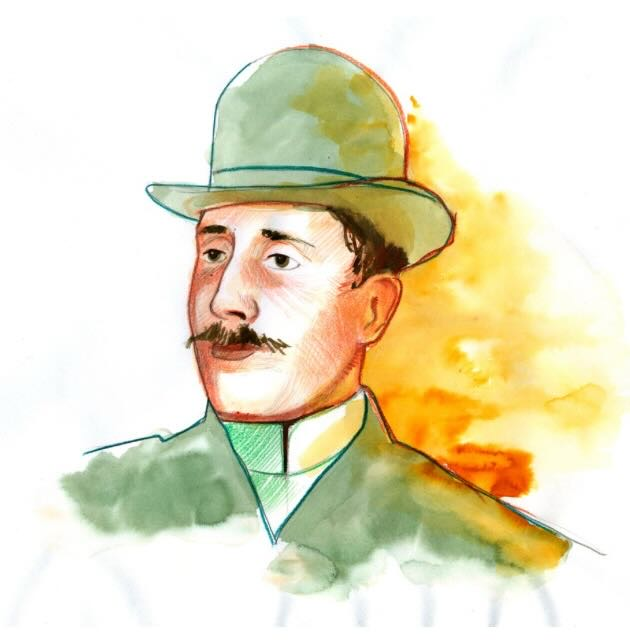
Born with the pen name Wilhelm Apollinaris de Kostrowitzki in Rome in 1880, this illegitimate son of a Polish mother and mystery father (most likely an Italian army officer) was by no means French. In 1902, Wilhelm – having settled in Paris to immerse himself in the avant-garde movement – became Guillaume Apollinaire. Just like that, the Polish had vanished like his father, and Guillaume was an adopted Frenchman. Before he wrote a single line of poetry that would reshape French Literature, Apollinaire had already laid down the principles of his works through the reconstruction of his name, his identity and his nationality. His story is a microcosm of his Modernist Literature itself: refusing the old, natural order of 19th-century French Symbolism, and expanding on it to form new, current movements like cubism and surrealism.
‘Zone’, Apollinaire's first poem in his 1913 collection ‘Alcools’ immediately encapsulates the poet’s desire for his poetry to have a greater immediacy than any traditional, French literature can offer, correlating with the rapid technological and industrial advancement of the early 20th century. The first line “A la fin tu es las de ce monde ancien” (“in the end you are weary of this ancient world”) suggests a need for poetry to drive forward and evolve. Apollinaire uses switches frequently between ‘tu’ (you) and ‘je’ (I) throughout the poem, creating intimacy between himself and the reader, suggesting that it is not just Apollinaire who is tired of the formal, French alexandrine and poetry littered with restrictive punctuation, but Modernity itself. The monosyllabic nature of the line increases the sense of fatigue evoked by the words. Apollinaire’s subsequent references to buses, cars and trains further highlight a desire for onward movement while recognising the evolution of transport thanks to the Industrial Revolution. The total absence of punctuation in ‘Alcools’ was revolutionary in poetry. The deliberate decision to strip all verse of full stops, question marks and commas creates a flow of words, untrammelled by formal boundaries which forces the reader to contemplate different meanings of the text. Creating ambiguity in meaning is a key idea of Modernism. The loss of punctuation also increases the pace of the poem, correlating with the bustling nature of urban life in the early 1900s which Apollinaire alludes to in ‘Zone’ when walking through the busy streets of Paris crowded with workers.
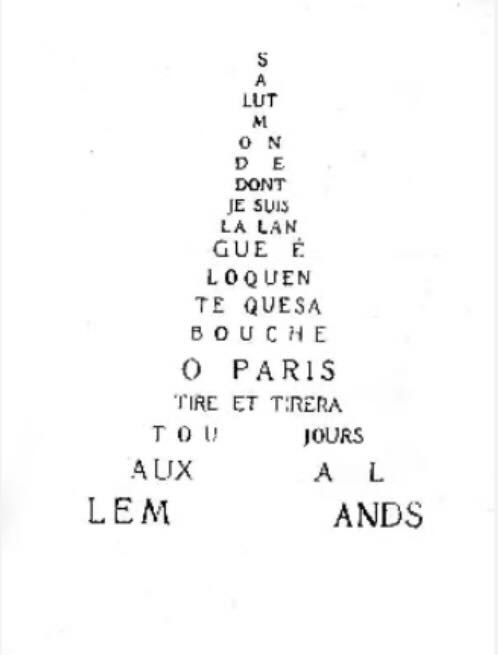
Beyond ‘alcools’, Apollinaire’s regeneration of French poetry extended in his publication of ‘Calligrammes’ (1918). In this collection, Apollinaire took this rule-breaking of poetry further still – reformulating the text into visual shapes so that it could be simultaneously read and seen to enhance meaning by blurring the boundary between poetry and art. In Apollinaire’s “La Tour Eiffel” (“The Eiffel Tower”), the verse is purposely shaped to depict the famous monument as a structure of French defiance towards the Germans in World War One. The monument is described by the words which make up its image as ‘la langue eloquent’ (‘the eloquent tongue’) which sticks out towards the Germans to mock them. This emphasises the French’s pride over the Eiffel Tower and their technological and industrial superiority over Germany in The Great War. The visual element of Apollinaire’s poems in ‘Calligrammes’ is a technique within surrealism – a 20th-century movement which Apollinaire coined.
Apollinaire passed away on 9th November 1918, just two days before Armistice Day from the Spanish Flu, having been previously weakened from a German shrapnel wound to the temple while fighting on the front line for France – his adopted nation. Whilst he just missed out on experiencing the peace he fought so hard to achieve, there is no question that the exciting new world of French literature that he rebuilt lived on. Many figures across the avant-garde movement thrived having been inspired by Apollinaire, including André Breton, the ‘founder’ of the surrealist movement, and artist Pablo Picasso. Most importantly, Apollinaire taught that the standard norms (not just in literature but anywhere in society) are not always sufficient: they can be torn up, remade or refined to create immense success.