By Misha O'
From the many wonders of Greek mythology arose a mythical bird called the phoenix. It has come to be a symbol of rebirth through its ability to rise from the ashes of its predecessor. Often depicted with bright, vibrant colours, we can clearly see why its immense mythical presence has come to the forefront of what it means to be reborn. However, the Slavic world often answers with a different bird: the firebird.
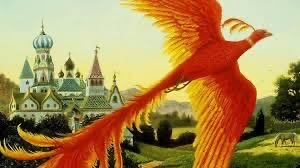
The firebird is described as a large bird which glows brightly with shades of red, orange, and yellow light. It also has striking eyes which are said to sparkle like jewels, above which sits a crest of feathers resembling a crown. This reflects the importance and status it possesses in Slavic folklore. Perhaps its most notable quality is its feathers. They allow the firebird to glow in the dark, and so much as a single feather has the power to illuminate an entire room and will not stop shining even if removed from the body of the bird. The parallels with the phoenix seem to be staring us in the face, which raises the question: why distinguish between these two creatures? Well, the firebird does not have the ability to be born again, which the phoenix most certainly does. Instead, its own magical qualities serve to teach us that renewal does not just come about through a brand-new beginning, but more often than not through transformation brought about by experience.
The firebird appears in many tales as a catalyst for change and development, bringing about a sense of captivation and wonder. However, this is often accompanied by a warning that hints at a danger behind its great allure. One example is its appearance in Tsarevitch Ivan, the Firebird and the Gray Wolf. The firebird is said to have stolen a golden apple from Ivan’s father, prompting Ivan to set out to capture it and sending him on a long journey. The firebird proves difficult to catch, and Ivan’s journey, set in motion by the firebird, leads to him being killed by his brothers; however, he is revived and marries Helen the Beautiful. The story develops Ivan from merely the overlooked youngest brother into the central hero, rewarded also with Helen’s hand in marriage. This change in his character, brought about by the firebird, relies on struggle and challenge rather than simple rebirth, highlighting a form of renewal that is far harsher and more demanding.
The bird also appears in The Firebird and Princess Vasilisa. In the story, an archer comes across the firebird’s feather and, although warned by his horse not to touch it, gives in to temptation. The archer experiences many troubles but eventually is proclaimed king and ends up marrying the princess. This once again depicts the firebird as a catalyst for change, as we witness the transformation of a simple archer into a king and husband to Princess Vasilisa.
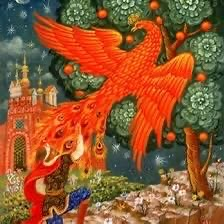
The firebird tales all follow a typical fairytale structure, with the feather acting as a premonition of a difficult journey. Beyond this, however, all versions of the firebird also share the same idea of prolonged resilience and eventual change, and it is clear to see why its legend has captivated Slavic folklore. We even see this in its prominence in literature and music, most notably in The Firebird, a ballet and orchestral concert work composed by Igor Stravinsky.
If we look to the phoenix for hope of starting anew, we can look to the firebird for the necessity of change, and we see in Russian culture that this is rarely effortless, instead requiring endurance and struggle. While the phoenix simply burns and rises, the firebird reshapes the world around it.