By Charlie T'
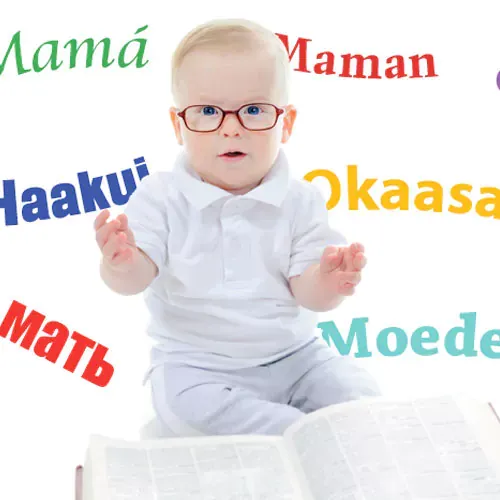
Do you remember your first ever French lesson? How do you begin to learn another language? You probably start with a small vocabulary, and a set of rules. Pleasingly, thanks to the Norman conquest, the vocabulary has some overlap with English, (table, police, musique) and the underlying structure is very similar: it’s in the same subject-verb-object word order, suffixes dictate who is doing the verb when, and plurals typically end in an ‘s’. So, even though it’s intimidating, you have a huge platform from which to start. What, though, happens when you have no such platform, when every interaction is a complete first? It’s a marvel that children after four years can reach effective fluency in their language, and a great testament to the brilliance of the human brain.
The question that arises from this observation is whether humans possess an innate language ability. The two schools of thought are nativism, which believes in such an ability, and empiricism, which does not. One of the main points of disagreement between the two is the ‘poverty of stimulus’ theory, which is nativist, and does not believe that children are subjected to enough language to fully learn all the grammatical rules, as there are too many possible things that can be said for children to have heard it all from their interactions. Empiricists refer to the indirect grammar rules that children would pick up and then apply to their own sentences, therefore making the numbers feasible. Noam Chomsky argued that all children are born with the Universal Grammar, which are a set of rules that aid with language learning, and this is most borne out by the creation of Nicaraguan Sign Language, which a group of deaf children in Nicaragua created, which had more complex grammatical rules than the adults around them were using. This implies that the adults had lost the ability to create such rules themselves, which is part of the maturational hypothesis: language is one of the only skills we don’t get better at learning, implying a separate mode of learning. With the advent of large language models, the empiricist view is being strengthened, as experiments show completely new models to pick up many of the same grammatical rules as human children who are hailed by nativists for doing so. The counter argument is that the models are being exposed to far, far more linguistic data than young children are, but the debate is currently ongoing.
Be that as it may, the fact that young children learn language so well is astounding. It appears much more of an instinct than something like maths does, and in some cases, babies are better than adults. Babies can differentiate between sounds which their parents can’t. Babies can also distinguish between languages before they can understand them, as they can recognise the melody of their mother tongue from inside the womb. And when they learn to speak, it’s just as impressive. Although everyone likes it when a three year old says “I taked” or “childs”, in an experiment in which three year olds were asked to describe pictures, their grammatical accuracy was over 70%, with individual errors rarely made more than once.
Whether language learning is innate or not, it is inarguable that human children possess an incredible gift, which we so often take for granted.
Bibliography:
Chomsky: Rules and Representations: 1980
Chomsky: Aspects of the Theory of Syntax: 1965
Lenneberg: Biological Foundations of Language: 1967
Wilcox, Futrell, Levy: Using Computational Models to Test Syntactic Learnability: 2024
Eimas: The Perception of Speech in Early Infancy: 1985
Mehler, Lambertz, Jusczyk, Amiel-Tison:
[Discrimination of the Mother Tongue by Newborn Infants: 1986
Eisenburg, Guo, Germezia: How Grammatical are Three Year Olds?: 2012